Quick brief
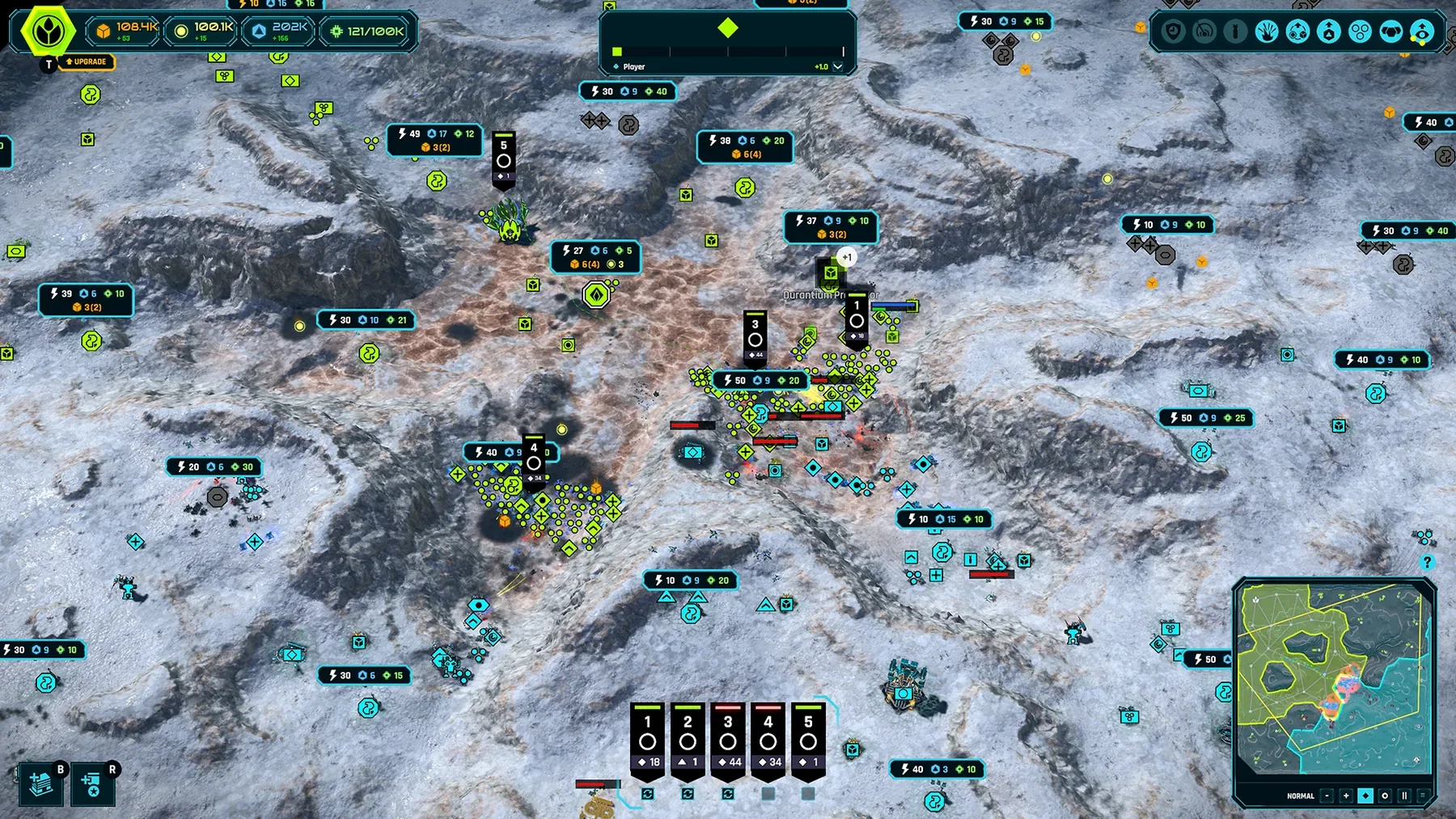
- A region is income, power, production space and a defensible route at the same time.
- Multiple buildings can share a region, but each one consumes regional Power.
- Forward production shortens reinforcement travel while increasing exposure.
- Quantum Archives multiply a region's output, making the richest contested regions worth fighting over.
Ashes II does not ask you to build one perfect base. It asks you to govern a network of regions while an enemy tries to break it.
That makes the economy a map problem. You are not only deciding what to build; you are deciding which pieces of the map can support the build, which can defend it and which can be cut off.
The region is the fundamental unit
A region can provide:
- baseline income just for being owned;
- regional Power that limits how many buildings it can support;
- space for production, economy and defensive structures;
- a route connecting other regions to your headquarters.
These are linked. A rich region with no power cannot become the production hub you want. A production hub with no safe route is a temporary advantage. A route with no defensible ground is an invitation.
When you look at a region, do not only read its yield. Read its job in your network.
Power replaced slots
Earlier in development, regions used a slot system. The current design uses regional Power instead. Each building has a Power cost, and different regions generate different amounts. You can build multiple structures in one region as long as the regional Power budget allows it.
This creates a more interesting decision than a fixed building count:
- Do you concentrate production in one highly powered region?
- Do you spread it across several regions so one raid cannot stop everything?
- Do you spend power on economy first, or on the structures that unlock the units you need?
- Do you upgrade a frontline region for a faster defensive response, or keep it lean and easier to replace?
There is no universal answer. The right choice depends on whether you expect to hold the region and how quickly the enemy can reach it.
Powerlines and flanking
The developers have shown powerlines and flanking as a tactical layer of the region system. Forward production is not only vulnerable to direct attack; the links that keep it powered can be cut.
This changes how a raid works. A small force that reaches a connecting region can cause disproportionate disruption without fighting the main army. It can threaten the power supply, delay reinforcements or force the defender to turn around.
Two rules follow:
- Do not put more value behind a single link than you can defend. Spread critical production when the map allows it.
- Look for the opponent’s critical link, not just their army. The most efficient attack may be against the infrastructure that makes the army possible.
What the economy produces
The pre-release material uses several economic terms. We separate what is clearly established from what is still not fully documented.
Metal and Elerite
These are the material resources associated with construction and advanced production. The first game used Metal and Radioactives; the sequel’s developers refer to Elerite as the renamed Radioactives resource. Official economy journals discuss how players should spend resources as they flow rather than waiting for a full stockpile.
Do not assume exact costs from the pre-release material. Build orders derived from a development build are hypotheses, not rules.
Quanta and Logistics
Stardock’s June 2026 region rework describes regions as earning baseline Quanta and Logistics. The official summary of that video also describes structures such as the Quantum Archive multiplying a region’s output.
For a new player, the important point is not the exact income number. It is that owning more and better regions changes your capacity to build and sustain an army over time. A player who stops expanding is not merely behind on resources; they are behind on the infrastructure that turns resources into presence.
Power
Power is the regional building budget. It is produced by the region and consumed by structures. It is not a global currency you can ignore by building a single reactor in the corner. The region itself is the grid.
The contested middle
The region video highlighted a deliberate risk-and-reward design: the richest regions sit in the contested middle of the map. Taking them can accelerate your economy. Holding them requires army presence and defensive investment. Losing them can hand a decisive advantage to the opponent.
This is one of the healthiest kinds of asymmetry. The safe expansion is less efficient. The efficient expansion is less safe. Your job is to choose which risk your current army can actually cover.
A useful test before taking a rich region:
- Can I see the approaches to it?
- Can I react before a raiding force cuts the link?
- Do I have a second source of the same resource if it is lost?
- Is my army close enough to defend it, or only close enough to watch it fall?
If the answer to those questions is consistently “no”, the region is not an opportunity. It is a future distraction.
Headquarters upgrades
Each faction’s headquarters can be upgraded twice. The final tier adds a unique turret that reflects the faction’s identity: a hard-hitting railgun for the UEF, area-effect artillery batteries for the PHC Nexus, and Serpentine turrets for the Substrate.
This is not just a defensive upgrade. It gives a faction a way to make its home region a harder target and changes how much force an opponent must commit to a direct attack.
Think about the timing. A headquarters upgrade competes with units and production. If you are under pressure, it can stabilise a region. If you are not under pressure, the same resources may create a larger advantage somewhere else. The decision is a read on the opponent’s next move, not a compulsory part of a build.
Production placement: the real economic decision
Every production building is both an economic asset and a military fact. The developers’ production journals describe how multiple production buildings speed recruitment and how new units spawn from suitable facilities before rallying to an army.
If all production sits at the back:
- reinforcements spend longer travelling;
- a fast attack can reach the frontline before replacements;
- your army has fewer local recovery options.
If all production sits at the front:
- a raid can cripple your replacement pipeline;
- a lost battle can become a lost production region;
- the enemy can target fewer, more valuable structures.
The practical middle is a layered network: a safe core that can rebuild, plus a forward node that shortens the journey for the fight you are currently fighting. Protect the route between them.
A simple economic review after each match
Do not grade yourself only by score. Review the decisions:
- Where did my economy come from? Did I own more regions at the end, or just hold the starting area?
- Which building was most power-constrained? Did I need more power, or better use of the power I had?
- How long did reinforcements travel? Was production close enough to the fight?
- Did I lose income to a raid I could have seen coming? Did I have a recon screen on the link?
- Did I overinvest in safety? Was the headquarters upgrade necessary, or did it delay an army that could have won the game?
These questions improve decision-making more than copying a build from a video.
Common economic mistakes
Expanding for the sake of expansion
A region that stretches your army beyond its ability to defend is a cost, not income. Expansion should create capacity, not require more defence than it returns.
Treating all regions as equivalent
A high-power production region, a rich contested region and a buffer region on a chokepoint have different jobs. Build for the job.
Ignoring the link
Players watch the front line and forget the route behind it. A cut link can do more damage than a lost skirmish.
Hoarding resources
The economy is designed to flow into production. A large stockpile is only useful if you are saving for something specific. Otherwise it is potential army that never arrived.
Building without a reinforcement plan
If the new units cannot reach the army, the production was wasted. Place factories with the next fight in mind, not just the current safety of the base.
What is still unconfirmed
Exact resource rates, all building costs, precise Quantum Archive multipliers and the full interaction between Quanta, Logistics and material resources are not documented in the public sources used for this guide. Those numbers can change before launch.
We will update the economy guide after launch with observed values and clearly dated assumptions. Until then, the strategy above is deliberately about decisions rather than invented spreadsheets.
The bottom line
Treat your empire as a connected system. Take regions that give you capacity, power the buildings that turn capacity into an army, and defend the links that hold it together. The player who can lose a region without losing the game is usually the player still in control.
Evidence log
Sources & method
This guide uses official Stardock and Oxide Games material wherever possible. Strategy advice is our own interpretation of those systems, not a claim about a hidden optimal build. Values and balance can change between the pre-release build and launch. Last verified November 1, 2026.
Continue the briefing